

Vol. 42, No. 07
07/01/2026
The Biblical Principles of Our Founding Documents
AT A GLANCE
• The origin of American liberty is the Bible.
• The United States is a Christian nation based on biblical principles.
• The American covenant consists of two founding documents: the Declaration of Independence and the U.S. Constitution.
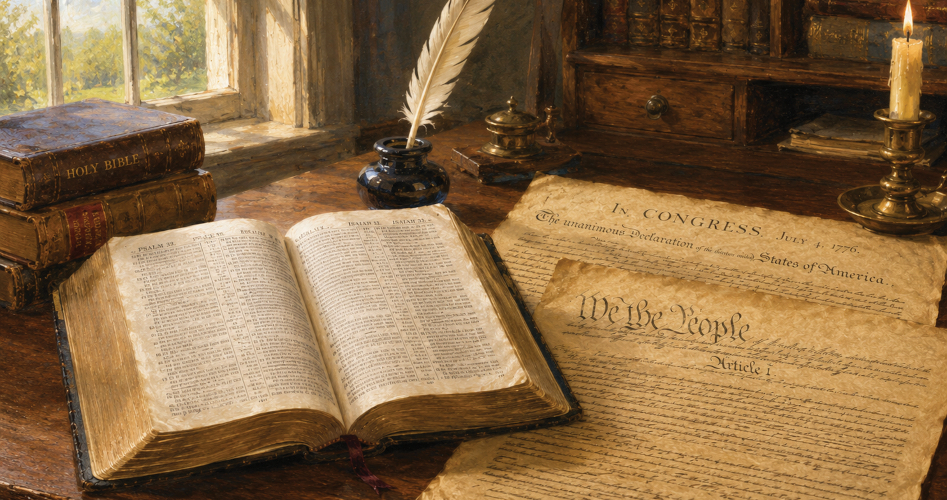
• Apart from the Bible and Christianity, neither the Declaration nor the Constitution could have ever been written.
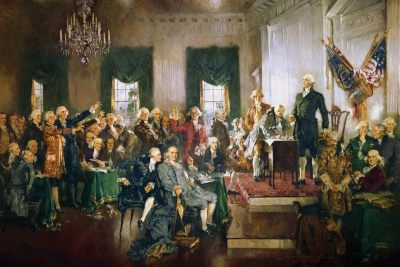
Two and a half centuries ago — with the adoption of the Declaration of Independence on July 4, 1776 — our Founding Fathers brought forth, as Abraham Lincoln noted in his Gettysburg Address, a “new nation, conceived in Liberty, and dedicated to the proposition that all men are created equal.” Less than 12 years later — when the U.S. Constitution was signed on September 17, 1787 — another “miracle” at Philadelphia occurred, in which the universal and timeless claims enshrined in the Declaration were codified, resulting in the establishment of the American Republic.
Both the Declaration and the Constitution have served our nation, and the cause of liberty, remarkably well. Now, as the United States commemorates its 250th anniversary, or semiquincentennial, it is fitting to ask: What led the Founders to accomplish the American Revolution? What ideas influenced their writing of two of the greatest political documents in history? And what makes 250 years of American freedom and independence worth celebrating and preserving today?
To answer these questions, we must look beyond the English Bill of Rights, the Mayflower Compact, the Magna Carta, and Anglo-Saxon common law. In fact, we must go back more than 3,000 years, before either ancient Greece or Rome. This is because the origins of America’s founding principles are found in none other than the Bible. Though it is now too often an untold story, the reality is that apart from the Bible and Christianity, neither the Declaration nor the Constitution could have ever been written.
While the Declaration and the Constitution are, in a sense, wholly and uniquely American creations, the biblical foundations upon which they rest are not. Indeed, the Bible is the basis for every fundamental right asserted in the Declaration and secured by key provisions in the Constitution. Given that the overwhelming majority of our Founders were Christians who shared a biblical worldview, the Bible was the primary textbook for their inspiration and example. It was the most-cited authority in their writings on government. Seeking to discover first principles, the Founders reverted to first sources. There was no better place for them to begin than the Bible.
Decades after the American Revolution, John Adams, in a letter to Thomas Jefferson, described “the general Principles on which the fathers Achieved Independence” as “the general Principles of Christianity.” Moreover, in a previous letter to Benjamin Rush, Adams called the Bible “the most Republican Book in the World.” The following makes the case that the United States’ founding documents are Christian documents, and explains why understanding the biblical connections between the Declaration and the Constitution is so important.
One People
The Declaration of Independence opens by describing Americans as “one people,” but that does not mean America became a nation in 1776. Our nation had come into existence more than 150 years prior to the Declaration. Although America was not a nation of “united States” that were “Free and Independent” of Great Britain until 1776, she was a nation nonetheless. Thomas Jefferson portrayed the Declaration as “an expression of the American mind,” indicating that, as Jefferson saw it, there was an America before its written Declaration. Why does this matter? Because it points to a much older America that was deeply rooted in the Bible and Christianity. It acknowledges the biblical, covenantal view of America embraced by our Founders. Only from the Christian perspective of America’s covenant relationship with God can we see how the United States emerged from the Declaration as a “new nation, conceived in Liberty.”
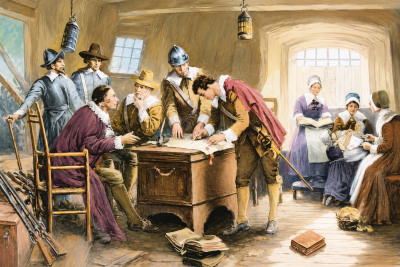
In 1620, with the landing of the Pilgrims and the signing of the Mayflower Compact, the Christian, covenantal concept of self-government gained a foothold in America. Our nation’s earliest Founders — including William Bradford, John Winthrop, and Thomas Hooker — conveyed a biblical vision that involved the people, “solemnly and mutually, in the presence of God, and one of another,” covenanting “together into a civil body politic.” Various covenant-style compacts, charters, and laws, such as the 1639 Fundamental Orders of Connecticut and the 1641 Massachusetts Body of Liberties, governed the American Colonies. Winthrop’s “city upon a hill” reflected the notion of a covenanted, chosen people (Matthew 5:14; 1 Peter 2:9) with a worthy mission in God’s divine plan for the world. By organizing Christian political principles into written documents, these Colonial compacts, charters, and laws provided the initial covenantal framework for American constitutionalism.
Our nation has a long and noble record of Christian covenants. The Founders defined Americans as “one people” in the Declaration of Independence when they came together to form a “new nation” based on a new American covenant. This new national covenant, which appealed to “the Supreme Judge of the world” (Psalm 9:8; Acts 17:31), united a whole and “good People,” in whose “Name” and by whose “Authority” it was “solemnly” declared.
The Laws of Nature and of Nature’s God
Like all covenants, the Declaration has an ultimate source of its authority — a highest and final decision-maker. Our Founders recognized that sovereignty is an inescapable concept in any society. As Christians, they believed that God alone is sovereign (Romans 11:36). Therefore, the Declaration mentions God four times: “Creator” (founder); “Laws of Nature and of Nature’s God” (legislative); “divine Providence” (executive); and “Supreme Judge” (judicial). Known to be the “Ruler of Nations” (Psalm 22:28), God appears in the Declaration as the founder and head of each branch of government (Isaiah 33:22).
In its first sentence, the Declaration invokes the “Laws of Nature and of Nature’s God” as the ultimate source of political authority. This is a legal phrase for God’s law revealed through nature (general revelation) and in the Bible (special revelation). Using the plural “Laws,” the Declaration distinguishes the law of nature and the law of God, who is over nature. Our Founders understood, in the words of Sir William Blackstone, that “Upon these two foundations, the law of nature and the law of revelation, depend all human laws.” Government, like marriage and the family, was ordained by God (Romans 13:1). Thus, God’s laws govern every person, in every circumstance, and in every age. God has written his laws into the constitution of the universe, even in the heart of man (Romans 1:20).
Despite its 18th-century legal prose, there should be no doubt as to whether the Declaration references the God of the Bible. Nearly all of the men who signed the Declaration, with few exceptions, were Christians who mutually pledged to each other their “sacred Honor.” In addition, the Continental Congress subsequently issued proclamations to the American people that were unmistakably Christian. For instance, the first National Thanksgiving Proclamation, from November 1, 1777, names all three persons of the Trinity, or Godhead: “Almighty God,” “Jesus Christ,” and the “Holy Ghost.”
Unalienable Rights
The Declaration states the main purposes of the American Republic, and its most impactful statement is that “all men are created equal, that they are endowed by their Creator with certain unalienable Rights, that among these are Life, Liberty and the pursuit of Happiness.” Our Founders viewed “these truths to be self-evident” due to their perception of both God and man. They accepted the biblical account that man was made in the image of God, as part of God’s creation mandate (Genesis 1:26). Man’s duty to obey God and take dominion over the Earth is what gives rise to rights among men. In other words, all rights are property rights naturally bestowed by God. Man is God’s property (1 Corinthians 6:19), and, accordingly, man’s dominion grants him a property interest in his own “Life, Liberty and the pursuit of Happiness.” As James Madison put it, man has a property in “his person” and “in the free use of his faculties.”
The Founders grasped that our “unalienable Rights” enable man’s chief end, which is to glorify God and enjoy Him forever (1 Corinthians 10:31). Protection of the individual and natural rights to life, liberty, and property allows every person to seek God and enjoy his blessings (Matthew 6:33), in fulfillment of the first and second greatest commandments: to love God and our neighbor (Matthew 22:37-39).
Consent of the Governed
Not merely does the Declaration defend God-given rights. It maintains the biblical position that “Governments are instituted among Men, deriving their just powers from the consent of the governed.” A covenant being a formal agreement between two or more parties that is publicly ratified and sworn by oath before God (Deuteronomy 10:20), the Bible places a covenantal obligation on the people. No people may be lawfully governed without their consent (Exodus 19:8; 2 Samuel 3:21). Besides, civil authorities are to be God’s servants for the public good (Romans 13:4). James Madison confirmed this, stating, “Justice is the end [goal] of government.”
Avowing that the “rights of the people” were conferred not by King George or Parliament, but by the “King of kings and Lord of lords” (1 Timothy 6:15), the Founders were biblically justified in exercising their duty to resist “absolute Tyranny.” Despotism is a material breach of the civil covenant. The Declaration formally “dissolved” a government wrongly initiated and implemented. Monarchy, let alone the “divine right of kings,” is irreconcilable with biblical Christianity. Jonathan Mayhew emphasized that “God gave Israel a king in his anger” (Hosea 13:11). Likewise, Thomas Paine noted that “Government by Kings was first introduced into the world by the Heathens, from whom the children of Israel copied the custom” (1 Samuel 8:7). There is no right to unlimited power (1 Samuel 13:13-14). The Declaration captured concisely what the doctrine of the lesser magistrates (1 Peter 2:13-14), not to mention just-war theory, had expounded on.
Republican Form of Government
At the Constitutional Convention of 1787, Benjamin Franklin admitted that the delegates had “gone back to ancient history for Models of Government, and examined the different Forms of those Republics, which, having been formed with the Seeds of their own Dissolution, now no longer exist. And we have viewed modern States all round Europe, but find none of their Constitutions suitable to our Circumstances.” The Framers of the U.S. Constitution could not rely on the failed experiments of their classical, medieval, or contemporary counterparts. Once again, they would make their arguments using the Bible.
In what stands as an incredible testimony to the role that the Bible had in the formation of America, the Framers favored the “excellent general model” of the Hebrew Republic. The Hebrew Republic covered the period in ancient Israel’s history from the Exodus to the coronation of King Saul. Unlike all other republics, the Hebrew Republic was an original government: the first federal republic. The core covenant made by God with ancient Israel at Mount Sinai — comprised of the Ten Commandments (Exodus 20:1-17) and the Book of the Covenant (Exodus 21-23) — was the Hebrew Republic’s written constitution. Algernon Sidney praised this constitution as a divine pattern for true liberty.
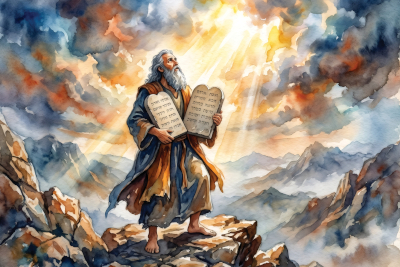
Samuel Langdon, a prominent Congregational minister who was president of Harvard University in 1774 and a delegate to the New Hampshire Convention in 1788, used the illustration of the Hebrew Republic to persuade Americans to declare independence and ratify the Constitution. His 1775 sermon “Government Corrupted by Vice, and Recovered by Righteousness,” preached at the Massachusetts Provincial Congress at the start of the Revolutionary War, depicted the Hebrew Republic as a “perfect republic.” He delivered his 1788 sermon “The Republic of the Israelites an Example to the American States” to the New Hampshire General Court before final ratification of the Constitution, during which he said, “the Israelites may be considered as a pattern to the world in all ages.”
More Perfect Union
“We the People” intended to make the American covenant “more perfect” with the U.S. Constitution. Akin to the Declaration of Independence, the Constitution also descended from biblical principles. It established the United States as a constitutional, federal republic. Federalism comes from the Latin word for covenant, foedus. The people, as “embodied into the several States,” covenanted together. The Constitution of the United States is, in effect, the “Covenant of the United States.”
In its preamble, the Constitution clearly states its biblical purposes to “establish Justice” (Amos 5:15); “insure domestic Tranquility” (1 Timothy 2:2); and “provide for the common defence [and] promote the general Welfare” (Romans 13:4).
Legislative, Executive, and Judicial Powers
Anyone who attentively reads the U.S. Constitution and the ancient Hebrew constitution cannot but be impressed by their resemblance. As careful students of the Bible, the Framers of the U.S. Constitution incorporated the fundamental principles of, along with an almost identical structure of operations from, the Hebrew Republic. The source of the Framers’ vision for a federal system was the decentralized, representative government of “thousands, hundreds, fifties and tens” in ancient Israel (Exodus 18:21-22). The same goes for the U.S. Constitution’s separation of powers laid out in Articles I (legislative), II (executive), and III (judicial) of the Constitution. Aside from ancient Israel’s several tribes and cities, the central or national government of the Hebrew Republic was divided into three branches: a chief magistrate, a council of 70 chosen men, and a general assembly of the people. The Hebrew Republic was not a “government of priests.”
Significantly, a number of specific clauses in Articles I through III in the Constitution were taken directly from the Bible. For examples, see Article I: “Sundays excepted” (Exodus 20:8) and “gold and silver” (Haggai 2:8-9); Article II: “natural born Citizen” (Deuteronomy 17:15); and Article III: “two Witnesses” (Deuteronomy 17:6) and “Corruption of Blood” (Ezekiel 18:20).
Free Exercise of Religion
The First Amendment, ratified as part of the Bill of Rights in 1791, may be the most misunderstood, if not the most important, provision in the Constitution. Beginning with the phrase “Congress shall make no law,” this amendment is a prohibition addressed exclusively to the federal government, not the several States. It prevents Congress from infringing on the religious liberty of the people.
Federalism, rather than secularism, was the Framers’ intent behind the First Amendment. Many of the States had explicitly Christian constitutions, with professions of faith and religious tests required for public office. But due to their different denominational leanings, the Framers decided to let the States adjudicate religious matters. This conforms with Article VI, Clause 3 of the Constitution, which prohibits religious tests for federal officeholders. There would be no national church establishment or detailed policy on religion. Government’s duty is to protect, not usurp, the Church (Numbers 18:7). The Framers saw a biblical balance between the civil promotion of “true religion” and the individual rights of conscience.
Done in the Year of Our Lord
The origin of American liberty literally begins and ends with the Bible. The Declaration of Independence is — via the Attestation Clause in Article VII of the Constitution — attached to the Constitution, done “in the Year of our Lord.” The last words of the Constitution reference not only the Declaration, but Jesus Christ. Our founding documents assume that Christ is Lord. They came into being because of the knowledge our Founders had of the Bible and their belief in it. As Thomas Jefferson confessed, the Founders did not aim to “find out new principles or new arguments never before thought of,” or “say things which had never been said before.” It was Christianity that shaped America’s founding.
The biblical principles of our founding documents reinforce each other. The U.S. Constitution was written pursuant to the Declaration. Consequently, the Constitution must be read in the spirit of the Declaration, and we must have a constitutional view of the Declaration. The Constitution was designed to preserve the principles of the Declaration like an “apple of gold in a frame of silver” (Proverbs 25:11). The Declaration has never been disannulled, nor can the Constitution be properly understood apart from the Declaration.
The American covenant consists of these two founding documents: the Constitution, which tells us how we should govern ourselves; and the Declaration, which tells us why. The former provides the structure of American government, and the latter provides its final cause. They are an inheritance left to our nation today by the Founders. Our forebears took seriously the covenantal promises of God to bless them and their posterity “to a thousand generations” (Exodus 20:6). George Washington cherished the fact that “No Country upon Earth ever had it more in its power to attain these blessings” than the United States. As Americans, we have a great Christian heritage. By the Providential hand of God, we live in the freest and most prosperous nation in history. But if we are to have any hope of remaining a “free people,” we must renew our nation’s commitment to God (Psalm 127:1). We must return to the covenant of our Founders. That is the only way to restore our Republic. God Save the United States of America! (Psalm 33:12).